
“Let food be thy medicine and medicine be thy food.” – Hippocrates
Optimizing digestion has become such a rich and deep topic of conversation. Whether it is about the role of fermented foods, what diet to try, or what nutrient rich foods to add in, we are tapping into the wisdom that the health of the gut is foundational to the health of the body as a whole. As a naturopathic physician this arena is essential to the way I approach patients, as diet and lifestyle can both encourage development of disease or the restoration of health. Recently, I completed a three-year program in Acupuncture and Chinese medicine at the Seattle Institute of East Asian Medicine (SIEAM), and I found myself particularly intrigued by Chinese medical theory surrounding dietary habits, digestion, and in particular a style of eating called qing dan.
In Chinese medicine, the primary digestive organs are the stomach and spleen (not to be confused with the anatomical spleen!) which rely on the physiologic heat of the body to digest food – so cooked foods are easier to digest than foods that are raw or cold and need physiologic heat to be warmed and then digested. The Chinese medicine spleen is more a conceptual organ that works alongside the stomach to break down the food into its pure components and impure components. The purified components are sent out to the body as nutrition while the impure substances are excreted as waste.
From this brief description it is easy to understand that if the spleen and/or stomach become injured, the rest of the body will suffer from a lack of nutrition. An injured spleen can manifest with symptoms such as lack of appetite, gas, bloating, or loose stools, while an injured stomach can manifest with symptoms such as nausea, vomiting, or frequent belching.
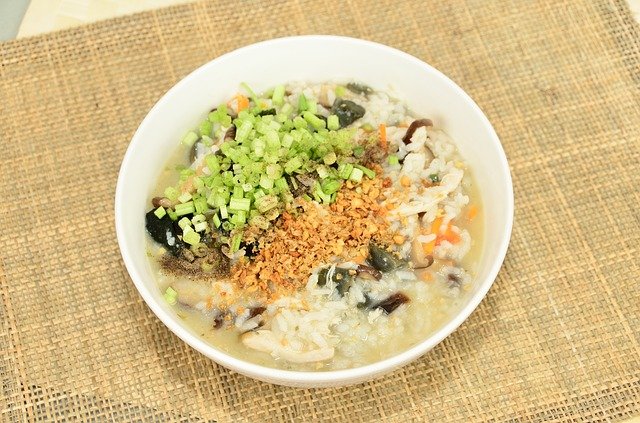
Enter the qing dan diet. Qing means ‘clear’ and dan means ‘light’, and it is a cornerstone diet for helping an injured spleen and stomach recover as the foods it emphasizes are cooked, warm, relatively bland without significant spice or seasoning, and thus are easy for the spleen and stomach to break down and absorb. I often recommend this style of eating for patients with newer digestive problems as a short term ‘reset’ over the course of 1-2 weeks, or I may recommend it for more chronic digestive issues as a longer-term addition to a more comprehensive plan. One of my favorite foods from this diet is a rice porridge called ‘congee’ or ‘jook’, which makes a simple but hearty breakfast or lunch depending on the ingredients added to it. I have included a recipe below for a basic congee for you to try yourself as well as some optional add-ons to enhance its nutrition and flavor:
Congee/Jook Basic Recipe:
Serves 4-6
Ingredients:
1 cup rice – white rice is preferred because it breaks down more easily, but brown rice works too
6-8 cups of water or broth
Salt and pepper to taste
Optional add ons:
For a hearty, savory congee: Boiled shredded chicken, grated ginger, topped with spring onion or gently sauteed mushrooms
For a lighter, breakfast congee: Grated ginger, cinnamon, goji berries, black sesame seeds
Method:
Rinse and drain the rice. Pour the rice into a heavy stock pot or slow cooker.
Add in the water and rice.
Bring the pot to a boil and then immediately turn down the heat. Allow the pot to simmer, covered, for 1-1.5 hours or until the rice has absorbed most of the liquid and mostly broken down. If using a slow cooker I like to set mine on low-medium heat and let it go for a few hours until the rice is broken down and most of the liquid is absorbed.
Season to taste, add additional ingredients, and enjoy.