
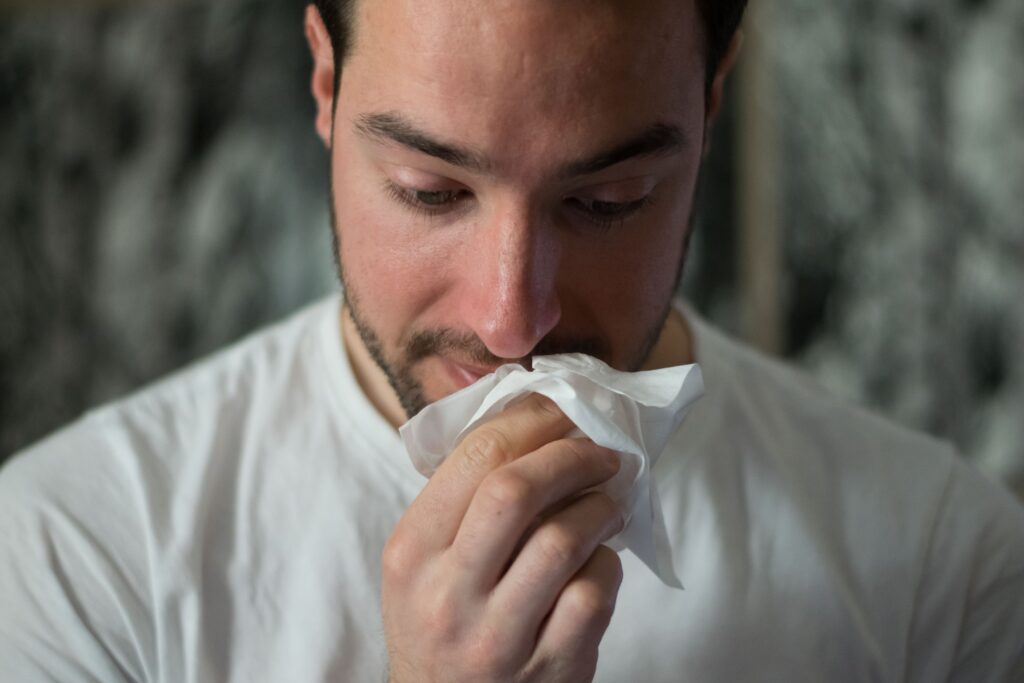

Seasonal allergies are one of the most common complaints I treat in my office. Like the sun slowly returning after months of Seattle gray, allergy symptoms have a way of creeping up on us. As the pollen counts rise our normal day to day can be a struggle with symptoms like a sneezing, itchy eyes, or fatigue that can make working and being outside unbearable.
If you suffer from seasonal allergies, you are not alone; according to the Asthma and Allergy Foundation of America more than 50 million Americans experience various types of allergies each year, and allergies are the 6th leading cause of chronic illness in the US. Some of the most common questions I’m asked about allergies are “Why do we have allergies? Why do my symptoms happen?”
The answer lies in the way our immune system responds to foreign matter. Fundamentally, the job of the immune system is to recognize foreign substances in the body, and to react to them if they are dangerous. For people who do not have seasonal allergies, the foreign allergens they are exposed to are viewed as harmless, so the immune system does not react to them and therefore we do not get symptoms. For people with seasonal allergies on the other hand, the immune system instead recognizes these foreign substances as harmful which sets the immune system on alert. This leads to a cascade of activity which leads to both local inflammation where the substance is first encountered such as in the eyes or nose, as well as generalized inflammation due to systemic immune activation. Therefore, we often get a mixture of local symptoms at those first encounter sites, such as the itchy, watery eyes and congestion or runny nose, as well as generalized symptoms such as feeling fatigued.
These processes are mediated by the release of an antibody called immunoglobulin E (IgE) from plasma cells, and histamine from special cells called ‘Mast cells’ which react to IgE. We do not entirely know why this response to allergens happens, but we suspect it has to do with certain genetic factors as seasonal allergies tend to run in families. Fortunately, there are many natural approaches that can help relieve allergy symptoms and help you feel better quickly. Here are three suggestions I often employ as a first step to help relieve seasonal allergies.
- Let food be your first medicine: While research has shown that certain nutrients can be helpful in reducing allergic burden, my first inclination is to use food rather than pills because of the wide-ranging benefits foods provide. B vitamins, Vitamin C, and the nutrient quercetin are helpful in preventing the release of histamine or helping to break it down more quickly which reduces the allergic response. They can be found in abundance in the following foods which may be helpful to increase while you have seasonal allergy symptoms:
- B vitamins – meat, poultry, seafood, eggs, leafy greens, and legumes
- Vitamin c – citrus fruits, strawberries, broccoli, kale, brussels sprouts
- Quercetin – onions, apples, cherries, citrus fruits, honey, leafy greens
- Reducing allergic burden in the home can also be helpful. Instead of wearing your shoes from outside throughout the house and carrying outdoor allergens with them, have a designated space near the entryway to leave them. Consider a HEPA filter for high traffic rooms and bedrooms to help scavenge allergens floating through the air. Wash your clothes with hot water and hypoallergenic detergent to better kill dust mites and remove allergens from linens.
- Clinically, I find so much benefit for my patients using acupuncture for allergies. Research has shown that acupuncture can reduce inflammatory responses, including those involved in allergic pathways. Acupuncture has also been shown to be able to lower IgE to dust mites, and reduce common allergy symptoms like nasal itch, eye itch, and sneezing. Best of all, it is practically painless, and people often can feel better within a few treatments.
Seasonal allergies can be tough, but they do not need to be unbearable. Give us a call at 206-400-7546 to take the first step towards allergy relief, naturally.
Citations:
American College of Allergy, Asthma, and Immunology. (2018, January 9). Allergy Facts. ACAAI. Public Website. https://acaai.org/news/facts-statistics/allergies.
Allergy Facts. ACAAI Public Website. (2018, January 9). https://acaai.org/news/facts-statistics/allergies.
McDonald, John & Smith, Peter & Smith, Caroline & Xue, Charlie & Golianu, Brenda & Cripps, Allan. (2016). Effect of acupuncture on house dust mite specific IgE, substance P, and symptoms in persistent allergic rhinitis. Annals of Allergy, Asthma & Immunology. 116. 10.1016/j.anai.2016.04.002.